Disclaimer: This post may contain affiliate links. If you make a purchase through them, we may earn a commission at no extra cost to you.
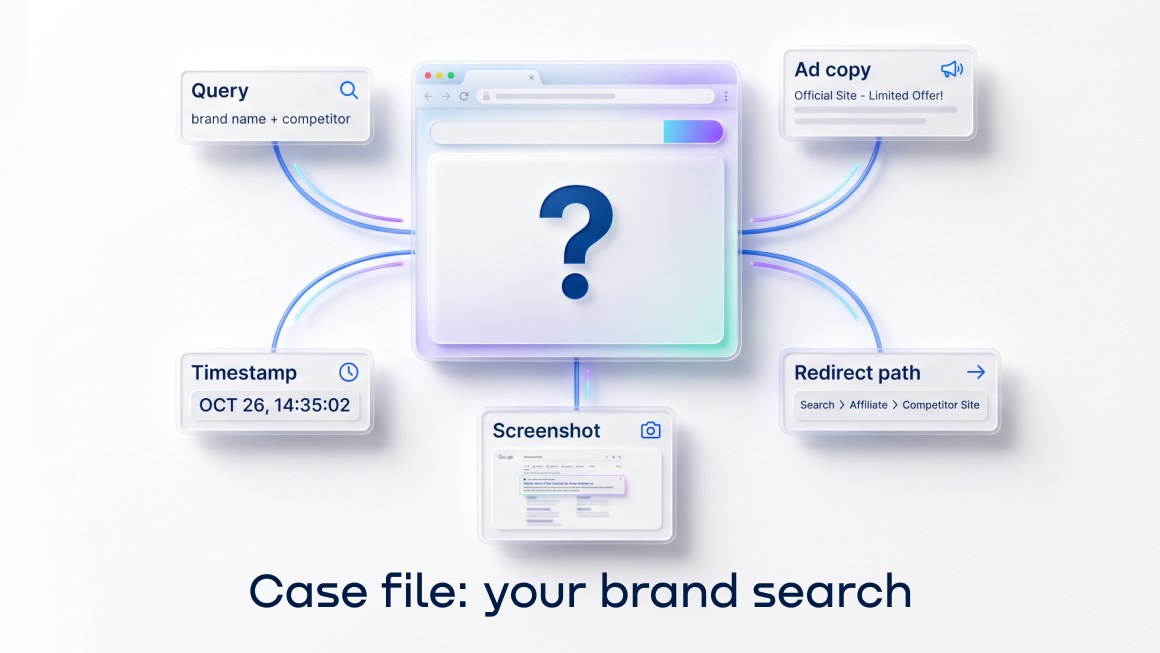
Why branded search needs its own performance review
If your branded CPC is rising, a general claim that “Google Ads is getting more expensive” does not reveal the underlying processes that affect your brand specifically.
In Tinuiti’s Q2 2026 US Google text-ad benchmarks, the median advertiser’s branded CPC fell 1% year over year, while non-brand CPC rose 4%. For e-commerce PPC teams, the benchmark is a starting point for investigating what is driving costs in their own accounts.
Changes in bids, budgets and query mix are worth checking. And so are affiliate ads competing for the same shoppers: do those ads coincide with changes in CPC, visibility or clicks? Manual spot checks can show only a snapshot of that competition. On the other hand, automated monitoring tools such as Bluepear capture ads across regions and times, giving teams records to compare with campaign results.
Bluepear catches affiliates and competitors bidding on your brand before they cut into your margins. You get saved ads, screenshots, and click paths across markets, devices, and times, giving you the evidence you need to confront partners.
G2 Leader in Brand Protection (Fall 2026).
Free trial, no card needed.

What affects retail campaign performance and returns
For retailers, a strong branded ROAS can coexist with shrinking margins. Promotions may lift conversion rates while discounts reduce profit per order. A campaign can meet its revenue-based target yet leave less profit due to advertising costs.
Consider a simplified example: at a €0.50 CPC and a 5% conversion rate, media cost per order is €10. If CPC rises to €0.60 while conversion rate stays flat, that cost reaches €12. With average order value unchanged, ROAS falls by roughly 17%.
Competing ads on branded searches can further influence who wins the click and how much the retailer pays.
An affiliate ad offers another route to the same store. For the retailer’s PPC team, this creates two potential issues. First, the brand and its partner may compete for ad space in the same auctions. That competition can increase CPC, depending on Ad Rank and other auction conditions.
Second, an affiliate ad can win a click that might otherwise have gone to the retailer’s own ad or organic listing. Under last-click affiliate attribution, the last eligible partner click receives credit for the order, essentially making the brand pay extra for the shoppers who were already close to buying.
How affiliate ads compete for existing demand
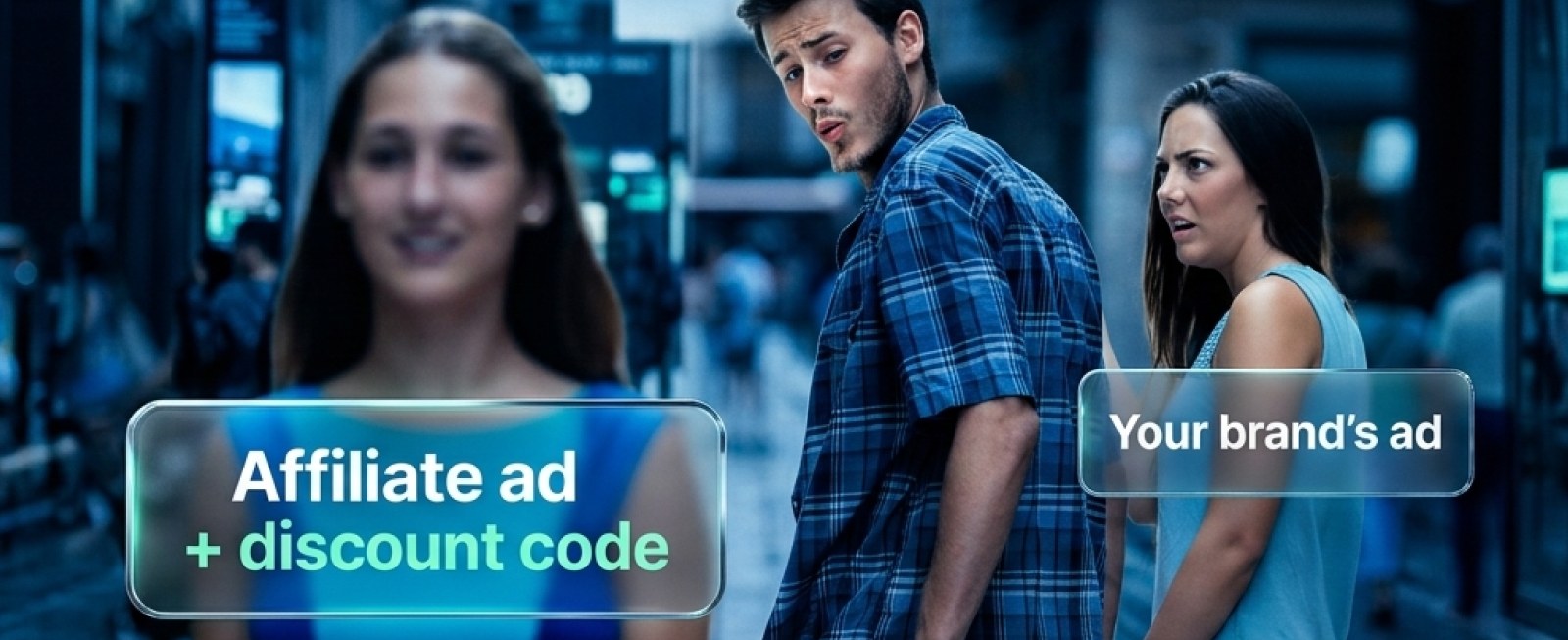
Consider a shopper who has chosen a jacket and searches for the retailer’s name plus “discount code” before checkout. An affiliate ad offers a deal, and the shopper clicks through. They may still complete the purchase on the retailer’s website, but arrive through an affiliate link, creating extra expenses for the brand that pays the commission.
It’s important to evaluate whether such users would otherwise go to the brand’s own ads or organic results. A high conversion rate on affiliate traffic may reflect shoppers’ readiness to buy; it does not establish how many additional orders the placement generated.
Why PPC reports don’t show the full picture
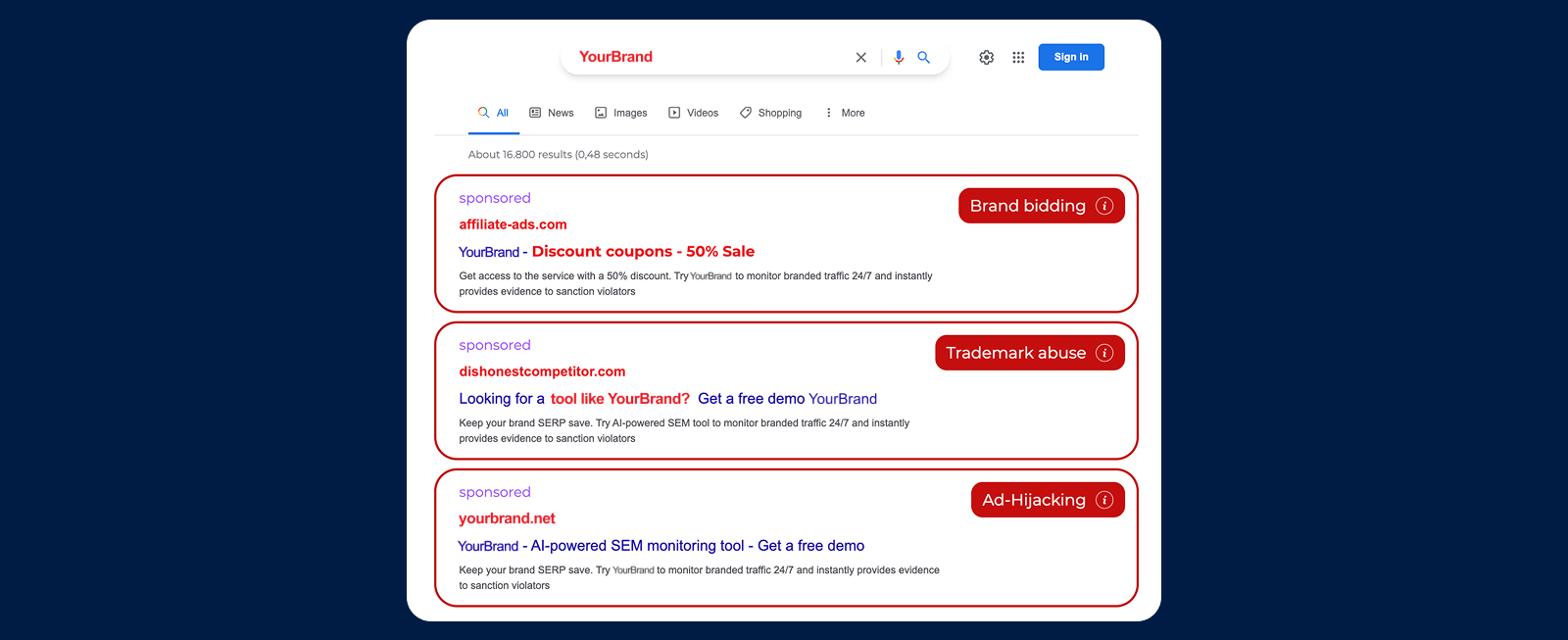
A manual search shows the ads shown for one query, location, device and time. If a partner advertises to mobile shoppers in another market during the evening, a weekday desktop check from the retailer’s office may miss it. Repeating the same check leaves that gap open.
Auction Insights provides a broader view of competition. For Search campaigns, Overlap Rate and Position Above Rate can help identify advertisers worth investigating. Reporting depends on minimum activity thresholds, however, and does not include competitors’ ad copy or click paths. A listed domain does not reveal the offer shoppers saw or whether their clicks passed through affiliate links.
Auction Insights highlights competitive patterns; inspecting individual ads reveals their messages and destinations. Regular checks across markets, devices and times help capture placements that occasional searches miss.
Case study: what monitoring reveals about affiliate ads
Bluepear saves the ads it detects, giving PPC teams records to examine after the live search results have changed. These saved placements give PPC teams specific details to investigate: a disputed offer, an ad that resembles their own, or a destination that needs checking. When contacting a partner, the team can point to the wording and click path in question and explain what needs to change.
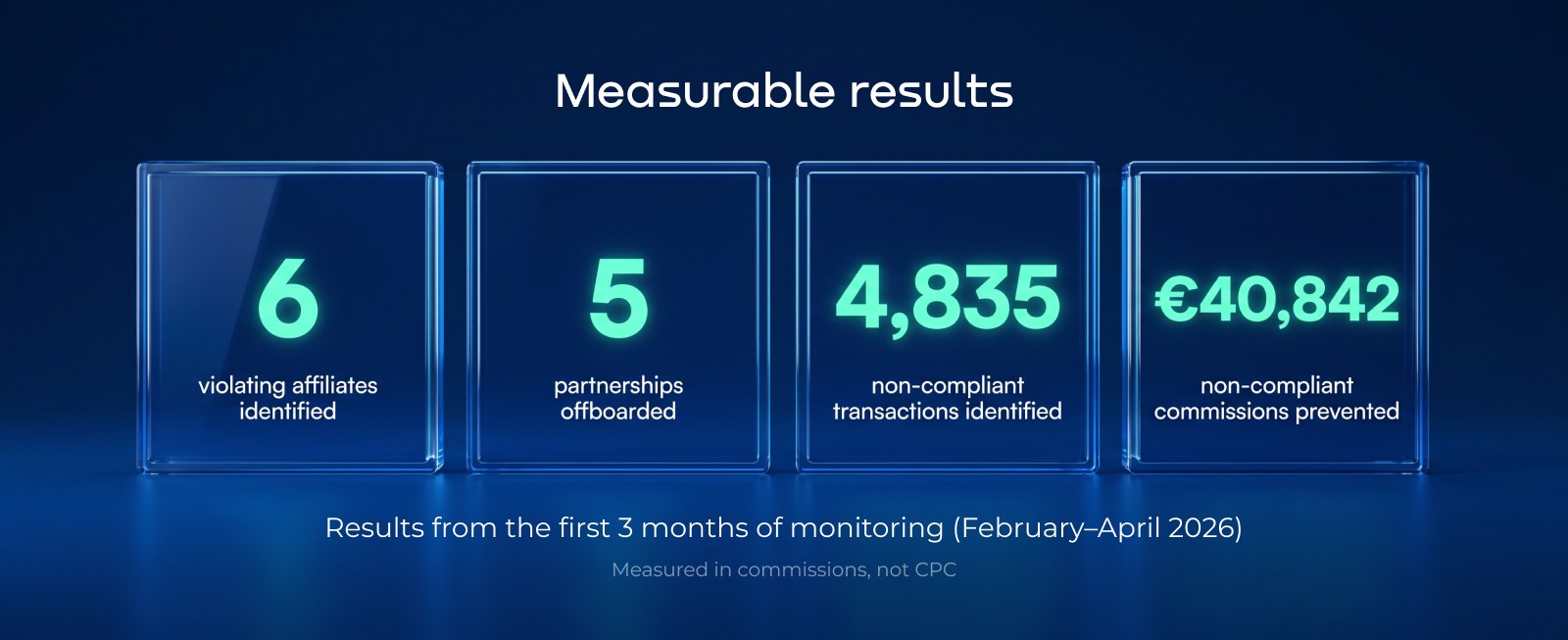
Otrium used Bluepear to replace manual spot checks with automated, round-the-clock monitoring of branded search across seven European countries. Over 3 months, monitoring revealed six affiliates bidding on Otrium’s brand keywords. Their ads closely copied Otrium’s own messaging, breaking the rules of the partner program. About half of these violations had not been suspected before. This revelation led to €40,842 of commissions being prevented and five partnerships being offboarded.
Setting up monitoring across locations, time zones, and markets
Start with branded queries and markets that account for substantial spend or show changes in CPC, clicks or visibility. Plan checks across locations, devices and times.
For multi-brand retailers, separate searches for the store’s name from searches for labels it stocks. A query naming a designer may bring several competing retailers into view, while a query naming the store is more specific to that business. Keeping these groups separate makes comparisons more useful.
For each placement worth investigating, save:
- The query, timestamp, time zone, search location and device type.
- The ad copy, display URL and a screenshot of the results.
- The landing page, any observed redirects and affiliate or tracking IDs you can verify.
If an ad resembles the retailer’s own, check its destination and any visible tracking. A familiar display URL alone does not establish who placed it.
Comparing search findings with campaign performance
Three checks help assess whether the activity warrants action:
- Competition and CPC: Compare Overlap Rate and Position Above Rate in Auction Insights with your CPC trend. These rates describe competition relative to your own ad appearances. Check changes in your own targeting, bids and budgets before interpreting a rise as stronger competitive pressure.
- Visibility and clicks: Review Search Impression Share, Search Top Impression Share, CTR and click volume together. Losing a top position can be linked to losing an impression, which helps explain changes in traffic.
- Promotions and traffic mix: Account for promotions and changes in query mix. Compare equivalent weekdays and examine markets separately. A larger share of clicks from an expensive market can raise overall average CPC even when CPC within each market stays flat.
A recurring pattern within comparable segments provides a basis for investigating further.
Taking action and measuring the outcome
Depending on the issue and the agreed terms, the next step may be to exclude specific brand terms, limit activity in certain markets or correct a misleading offer. Record the requested change, who will make it and when it takes effect.
Continue monitoring to see whether the ads reflect the agreement. Then compare campaign performance before and after the change:
- Review CPC, Search Impression Share, Search Top Impression Share and click volume in the affected segments.
- Check conversions and ROAS alongside total sales and profit. Fewer conversions attributed to paid search may reflect a shift to organic or direct traffic rather than lost orders.
- Compare equivalent weekdays and account for promotions and stock availability.
Record any changes to your own campaigns during the review period so their effects are not mistaken for the result of the partner’s action.
Could partner search activity generate incremental sales for the brand?
When affiliate brand bidding is permitted, the question extends beyond campaign CPC: does the activity generate additional orders at an acceptable cost?
If traffic volume and partner cooperation allow, a controlled test can help. One option is to pause the activity in selected markets while leaving it unchanged in comparable control markets. Agree on the primary outcome, test duration and sample size with the measurement team before launch.
Assess total orders and revenue after discounts and returns across channels. To judge profitability, also account for product costs, media spend and affiliate commissions. The control group helps estimate how sales would have changed without the intervention.
Start with a priority set of branded queries and identify the placements that warrant review. Use Bluepear’s monitoring to document the activity, then evaluate any agreed changes against campaign performance and overall profitability.
Bluepear catches affiliates and competitors bidding on your brand before they cut into your margins. You get saved ads, screenshots, and click paths across markets, devices, and times, giving you the evidence you need to confront partners.
G2 Leader in Brand Protection (Fall 2026).
Free trial, no card needed.
Hana Kobzová is a freelance PPC specialist and the founder of PPC News Feed. Named among the TOP 100 Most Influential PPC Experts 2026, she is also a Google Ads Product Expert and a Microsoft Advertising Certified Professional. Hana delivers clear updates and actionable insights that help marketers save time and work smarter.