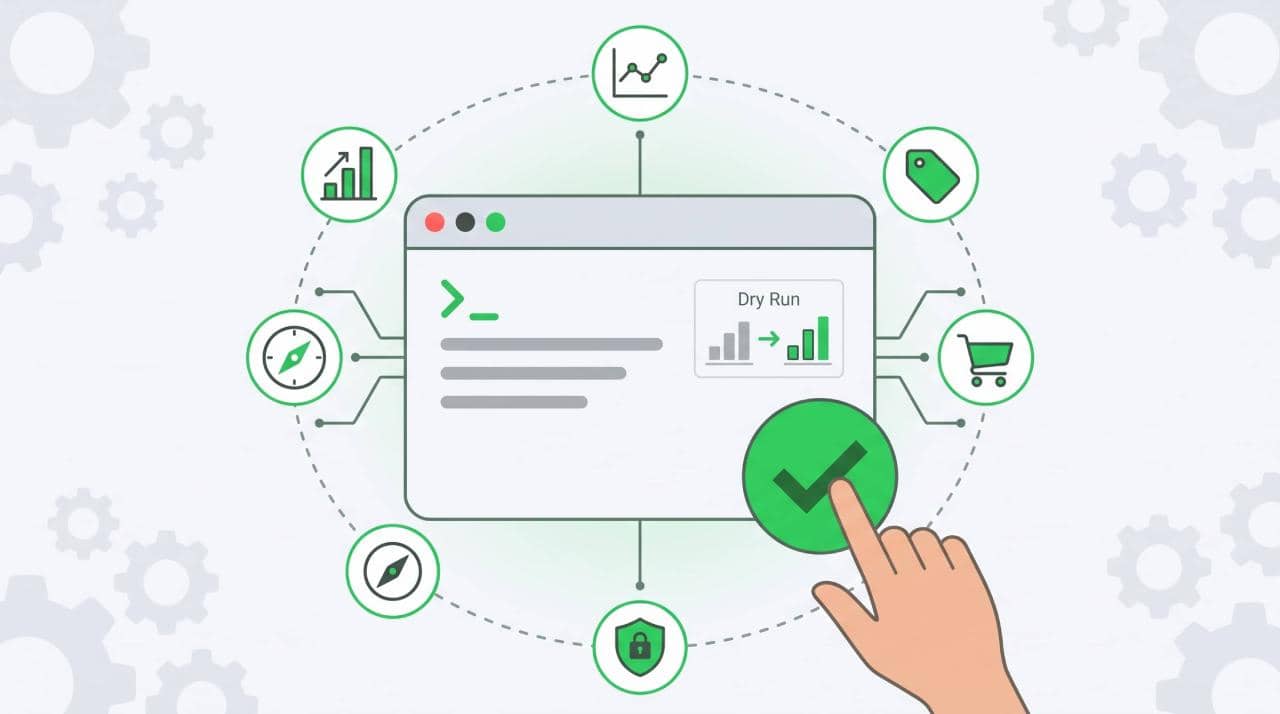
Buying access to a powerful AI agent does not give anyone an edge on its own; its true value depends on how it is used. The real edge comes from the ability to handle a client’s business context, a well-thought-out strategy and market instinct earned through years of practice. AI cannot turn a messy setup into an orderly one; it only makes the mess grow faster. BDOS.ai was designed with this in mind: it is not a shortcut that lets you switch your brain off, but a test of how mature your way of working really is.
Who built BDOS.ai and what it does
BDOS.ai comes from two Google Ads practitioners, Karol Dziedzic and Krzysztof Bycina, and it is aimed at people who manage paid search and analytics every day. The assistant connects to live ad accounts, reviews campaigns, flags issues and suggests fixes. Nothing is applied until the specialist signs off, so the final call always belongs to a person.
Stop clicking through Google Ads, GA4, GTM and Merchant Center one tab at a time. BDOS.ai pulls the data, flags issues and drafts fixes through the API, and nothing goes live until you approve it. It runs locally, so your client data stays on your computer.

From scripts to direct API access: where the claimed 20-fold gain comes from
Marketing tools have gone through several generations. First everything was done by hand in the interface. Then Google Ads Editor and custom scripts took over the most repetitive jobs. The biggest leap, however, came only once modern AI models were plugged straight into the Google Ads API, GA4, GTM and the Merchant API, removing the technical and time constraints that previously held specialists back.
The two creators of BDOS.ai describe the change in their own words (quotes translated from Polish):
Krzysztof Bycina on the technical breakthrough and working with the API:
The technical side of Google Ads has always been closest to me. That is why working directly on the API, combined with AI agents, feels a bit like a dream come true.
For years I built solutions on Google Ads scripts. They helped in everyday work, but they only cover part of what the API offers.
Two things blocked the move to the API: technology and time. AI removed both barriers.
Today we build a new BDOS feature that genuinely makes a Google Ads specialist’s work easier in a few weeks, sometimes in a few days. For me that is a phenomenal change.
Karol Dziedzic on how the industry has evolved and winning back time for strategy:
It is amazing how much technology can increase the efficiency of Google Ads specialists.
I remember the days of clicking through the interface by hand. Then came Google Ads Editor, followed by scripts and the first automations. Each of those steps saved us hours, but none of them gave full access to the account.
Working directly on the API, combined with AI agents, is the next stage of that evolution. In my experience it gives experts an almost twentyfold speed-up while keeping the same precision.
As a result, we implement strategy, audits and optimisations in real time. We stay ahead of the market technologically and win back time for what matters most in this job: thinking about strategy and building an edge over the competition.
The autopilot myth: an agent needs a solid process more than a clever prompt
Anyone who has worked in paid media at a senior level knows the daily juggling act. One tab holds GA4, another Google Tag Manager, then come Merchant Center, Looker Studio, several client accounts in Google Ads and an overloaded Google Sheets file. You track hundreds of metrics, keep reviewing keywords, products and anomalies, and spend hours clicking through screens to export basic reports or confirm that an e-commerce event fires correctly.
Against that background, an AI agent like BDOS.ai looks like a way out. Instead of navigating one interface after another, you talk to your data and let the agent carry out tasks through the API. It feels like trading a pile of spreadsheets for a dedicated operating system.
That is exactly where a dangerous belief took hold: that an AI agent can stand in for strategy and make expertise unnecessary. In reality, it works the other way round.
The winners in the AI era will not be the people with the fastest model, but experienced specialists who control context carefully and never skip verification.
An assistant for mature teams, not a replacement for them
The most common mistake with tools like BDOS.ai is expecting them to produce results by magic. Think of the agent as a very capable operations assistant instead. In an organised company with a clear direction and reliable data, it multiplies your output. In a disorganised one, it simply creates more disorder, only much faster.
Strategy still has to come from you. BDOS.ai reads GA4, Google Ads and Merchant Center data quickly and accurately, yet all it sees are figures and transaction records. Anything agreed outside those systems stays invisible to it.
The agent becomes truly useful when the data it pulls through the API is combined with knowledge that only the specialist has:
- What the business needs right now: shifting margins, upcoming price rises, logistics limits and strategic arrangements made with the client.
- How the work should be done: tested optimisation routines, your own campaign structure blueprints and the rules you follow when writing ads.
Your knowledge stays on your machine
BDOS.ai is a desktop app. Prompts, strategy notes, project context and access tokens are saved in a local database on your own disk. None of it is used to train outside models, which means you can grow a tailored knowledge base without worrying that confidential information will leak.
Chatbot or operational agent: what BDOS.ai actually is
The reason this tool demands maturity becomes clear once you compare an ordinary AI chat with an operational agent.
A chat assistant lives in its own window. You paste a report in, receive an analysis, and then do all the implementation yourself, copying changes into Google Ads, GTM or Excel by hand.
BDOS.ai works inside your systems instead. Through API connections to advertising and analytics tools, it relies on a validation engine, current Google Ads API interfaces and integrations with the Merchant API and GA4. It was shaped by more than ten years of hands-on experience from Karol and Krzysztof, and that shows in how well it understands a specialist’s daily problems and in the observations it brings back after reviewing campaigns. Beyond analysis, it drafts and proposes recommendations, warns you when a change looks too aggressive and executes concrete operations.
With that much power comes real responsibility, which is why safe use depends on a human in the loop. Nothing happens behind your back, and every task follows the same sequence: read, analyse, preview, approve, execute.
The key protection is Dry Run, a simulation mode in which the agent shows precisely what it intends to change before anything is saved. For example, before you attach a brand exclusion list, you can see exactly which campaigns will be affected.
Privacy and data security
Because BDOS.ai runs locally, it has a clear architectural advantage. The app starts on the user’s own computer, so tokens and credentials for Google Ads, GA4, Merchant Center and GTM never pass through a third-party middleman’s servers. The creators have no central dashboard of their own and keep no copies of your clients’ account data.
That said, it helps to keep the bigger picture of data flows in view. BDOS.ai talks directly to Google’s infrastructure and to AI models such as Claude. Anyone deploying it should decide deliberately how much context to share and review the data processing terms of the model providers themselves.
Case study #1: a safety check in action in Google Tag Manager
In one account, a GTM conversion tag had no trigger attached, so nothing was reaching GA4. BDOS.ai spotted the problem by itself and drafted a fix.
Rather than pushing the fix live, it paused and requested approval. I answered by giving it an unrelated task, which a less sophisticated bot might have misinterpreted as a green light. BDOS.ai noticed that it had not received a clear yes, held back the change on the production account and asked me to confirm what I wanted.
What makes an AI agent valuable is not raw speed, but safeguards that keep client accounts safe from changes nobody intended.
What this shows: the real strength of an AI agent in marketing is not how quickly it can build a structure. It is the discipline that forces a person to stay calm, review the preview and make a deliberate decision. And if you forget to give a clear answer while chasing a better CPA, BDOS.ai will come back later to remind you and ask how to proceed.
Case study #2: seven risks that appear when context is missing
Performance marketing punishes shallow work, and agents are no exception. In ad and analytics platforms, missing context quickly turns into poor budget decisions and money spent for nothing.
Experience with real accounts points to seven recurring types of risk that every specialist should watch for:
1. How an agent’s mistakes happen
When I asked BDOS.ai to reflect on its own missteps during our review session, it described the pattern better than I could (if you use it, try asking the same question). Here is its answer:
“Almost all of my slip-ups follow one pattern: I fill a gap in the data with my own guess instead of asking or checking, and then I present the guess in the same tone as a fact. Three things caught it: your live tests, the mandatory preview before every change, and the fact that you tell me straight when something is wrong.”
In other words, just three things keep errors like these out of production: testing on live data, previewing every change and verifying without exception.
2. Invented values that were never checked at the source
A language model will sometimes guess a figure or a currency rather than confirm it through the API or on the client’s site.
- What happened: while setting up a dataLayer configuration, BDOS.ai filled the code with fictional EUR amounts, even though the site it was analysing clearly listed prices in PLN.
- Why it matters: the code carried wrong prices and the wrong currency. Deployed without a check, it would have skewed e-commerce reporting and sent incorrect conversion values to GA4 and Google Ads.
- What to take from it: every agent makes mistakes. This is precisely why the human-in-the-loop rule is non-negotiable: catching hallucinations before they go live is the specialist’s job.
3. When API structures do not match the real world
Errors caused by reading variant API fields or nested data structures as if each were a separate business entity.
- What happened: reading account links from the API, the agent treated several link and association types stored in one variant field as three different Google Merchant Center accounts, then built an action plan on that false premise.
- Why it matters: time goes into elaborate fixes for problems that do not exist anywhere in the client’s setup.
4. Missing history and time context (alerts with no baseline)
Evaluating performance based on a single snapshot, or on hidden conversions, while ignoring the timeline and when the campaign actually started.
- What happened: looking for a broken conversion setup, or running a detailed performance review, on an account that had gone live only the day before and had nowhere near enough data.
- What to take from it: good monitoring, such as GA4 alerts, should not compare today with yesterday. It should use the median of matching weekdays over a longer window, for example two to four weeks, and it has to distinguish falling demand from a tracking failure, where traffic looks normal but key events suddenly hit zero.
5. Forgotten agreements that live outside the platform (Consent Mode and exclusions)
Overlooking business and legal rules that are not stored in campaign settings but come from arrangements with the specialist or from GDPR and ePrivacy obligations.
- What happened: phone calls were put back among the primary conversion goals, or tracking tags were added in GTM without checking them against the fixed list of Consent Mode v2 signals.
- Why it matters: a tag deployed without the right consent handling will either never fire with permission or will breach user privacy and undermine consistent conversion modelling.
6. Guesswork that spreads between accounts
The point at which the agent carries findings or tasks from one client account into another, and an untested assumption starts to read like an established fact.
- What happened: in a combined report, budget details from different projects got mixed up, and a guess was presented with the same certainty as data confirmed through the API.
- Why it matters: solid analysis gives way to something that only looks correct, and a decision may be made on the wrong account.
7. Incomplete data and the “clean dashboard” illusion (iOS vs Android)
This mistake comes from treating Google Ads or GA4 reports as the only source of truth, even though mobile platforms intentionally restrict or delay the signals used for attribution.
- A typical scenario: you advertise a mobile app. A user taps the ad, installs the app from the App Store and two days later spends 500 PLN in it. On iOS, Apple’s ATT rules and the SKAdNetwork / AdAttributionKit frameworks either break the link between that click and the purchase or report it days later and only in aggregate. On Android, GAID identifiers and the native Google Play integration let the same data arrive almost immediately.
- What the AI concludes: looking at the last 48 hours in the dashboard, BDOS.ai sees ROAS collapse and zero conversions on iOS. Its maths leads straight to this recommendation: “The iOS campaign is unprofitable, pause it or cut its budget by 80% in favour of Android”.
- Why the AI cannot get this right on its own: it only knows what the API gives it. Events Apple never passed to the ad platform simply do not exist for it, and neither does anything recorded in your own backend (CRM, databases, payment systems) unless a dedicated attribution setup connects them.
A compass, not a captain: what the senior specialist is for
The iOS versus Android case makes the limit of AI very concrete, and it shows why successful performance marketing still depends on an experienced specialist.
An AI system can only reason from what it sees in Google Ads, GA4 or Merchant Center. A seasoned senior knows that good business decisions require looking well beyond those screens.
Why the important calls happen outside the ad platform
Strategic work today means checking the backend and comparing what the ad platforms report with the money that actually lands in the company’s account. A person grasps things the algorithm cannot work out from partial data:
- True value in the backend: the iOS campaign that looks like a loss in Google Ads may in fact be delivering the most valuable users, with the highest lifetime value (LTV), once you look at backend data.
- Patience with delays: a gap in recent iOS conversions is not a bug but Apple’s intentional privacy delay, so rather than pausing or cutting the campaign, the specialist looks for an overall rise in sign-ups in the backend.
- Knowing each platform’s rules: Android can look stronger in the dashboard simply because it is easier to attribute, not because its traffic is better.
When the specialist’s decision looks wrong to the agent
Here lies an interesting paradox. Suppose an experienced specialist decides to raise the budget of a campaign whose ROAS looks terrible in the ad platform. BDOS.ai may see that as an irrational move, or even as a mistake by the operator.
Ask the agent to assess that decision and it will reply: “This change contradicts optimisation principles”. The reason is simple: the business context behind the decision is not available through any API. The agent has no idea that the specialist has just reviewed the account, totalled up backend revenue, dug into the available data and linked facts that the ad platform itself could never link.
What no algorithm can know by itself
- Whether falling ROAS is the result of weak optimisation or of a planned sale to clear stock.
- Whether a higher cost per acquisition (CPA) is fine because a new product line carries a better margin.
- What has been agreed with suppliers and which logistics constraints the company is currently dealing with.
People add value by spotting opportunities nobody is using yet, forming bold hypotheses and designing tests an algorithm would never propose. Original thinking is our contribution: new positioning, fresh angles in the story a brand tells, careful management of Merchant Center data and multi-stage funnels built in Demand Gen.
An AI system such as BDOS.ai takes the heavy lifting off our hands: it pulls data together, detects anomalies within seconds and strips the routine clicking out of the working day. Still, the specialist remains the captain, reading the signals, testing them against business reality and owning the decision about where the whole operation goes next.
The B-D-O-S-AI checklist: is your team ready for an agent?
Before an AI agent becomes part of your everyday Google Ads or GA4 work, run through this short framework to see how prepared your organisation is:
| Element | Question to ask | What it looks like in Google Ads / analytics |
| B: Business problem | Which specific, repeatable process issue are we trying to fix? | Bringing an account audit, anomaly monitoring or the build of a PMax / Demand Gen campaign down from 4 hours to 45 minutes with no drop in quality. |
| D: Data | Can we trust our analytics, account setup and data sources? | E-commerce events verified in GTM with Consent Mode v2 in place, a checked feed in the Merchant API, a known campaign launch date and a backend that is connected to the rest. |
| O: Operating process | Are the checklist, procedures and validation rules written down? | A compulsory preview stage (Dry Run), live tests of events and a rule that every change needs explicit approval before it is saved. |
| S: Strategy | Does the tool serve our most important growth lever? | Freeing the specialist to work on less obvious hypotheses, backend analysis and margin improvement instead of clicking through interfaces. |
| AI: Experiment and scale | Are we starting with a small test and measuring the outcome? | Trying the agent on a single account, logging the mistakes it makes, building your own library of procedures or skills, and scaling only after that. |
What practitioners say about the changing role of the specialist
Ideas about what AI agents might do only become meaningful when they are tested against the experience of people who manage client budgets and accounts every day. Their view is consistent: the point is not to replace specialists, but to change what clients are really paying for. (Quotes translated from Polish.)
Marcin Wsół on shifting the weight of the work:
From my perspective, the biggest value of tools like BDOS.ai is not that they can make decisions for the specialist, but that they significantly shorten the path from a question to the data needed to make that decision. In everyday Google Ads work, a large share of the time goes not into the analysis itself, but into getting to the right data, putting it together and doing many repetitive tasks. If an agent can do that part in a few seconds, the specialist can spend more time interpreting results, on strategy and on finding the reasons behind what is happening in the account.
At the same time, as these tools become more capable, the experience of the person using them matters more. The easier it is to make a change in the account, the more important the question becomes: not “can we do it?”, but “should we do it?”. And this is exactly where knowledge of the client’s business, the account history and the specialist’s experience still matter enormously 🙂
In practice, AI does not so much eliminate the Google Ads specialist’s role as shift its weight from operating the interface towards interpreting data, strategy and controlling automation.
Artur Smolicki on the new standard of analysis and looking for growth:
For years, a Google Ads specialist’s job was mostly associated with clicking in the interface: changing a bid, adding exclusions, switching the strategy. That has long stopped being enough. The client does not pay for clicking, but for finding conversions, sales and leads where others are not looking for them. And that is where BDOS.ai has changed my work the most.
With BDOS.ai I can analyse data much more deeply than time allowed when working by hand. I can put campaign results side by side with GA4 data, the Merchant Center feed and the GTM configuration, compare them over a longer period and test hypotheses I simply did not have the hours for in a week. Which products have potential but do not get budget? On which search terms is the client losing sales? Instead of asking myself these questions once a quarter, I can come back to them regularly on every account.
For the client this makes a real difference. They no longer get a specialist who makes sure the campaigns “keep running”. They get someone who actively looks for additional conversions: in the data, in the account structure, in the product feed, and even in whether the measurement itself is correct. BDOS.ai takes over collecting and combining data, and I can focus on what it means for the business. That is how I understand the specialist’s role today: less operating the interface, more analysis, conclusions and responsibility for the client’s results.
BDOS takes on all the tedious work we did by hand until recently. Creating dozens, if not hundreds, of ad groups with highly personalised copy is now a possibility that translates into real business results. Analysing tens of thousands of search terms and categorising them by purchase potential or performance gives me a powerful base for my own analysis. Combining the data BDOS generates with other analytics tools gives an unprecedented level of detail and room for optimisation.
Conclusion: a higher bar for Google Ads work
BDOS.ai and other operational agents are not here to push experienced marketers out of their jobs. What they do is raise the standard of maturity expected from anyone who manages campaigns.
The practitioners quoted here agree: the specialist’s role is moving, for good, away from mechanical work in the interface and towards deep analysis, strategy and accountability for business outcomes. Once an agent can gather data, surface anomalies or build account structures in seconds, what matters most is knowing which questions to ask and how to read the answers.
Today’s competitive advantage belongs not to whoever runs the quickest AI model, but to whoever gives it precise context, keeps the data in good shape and stays fully in charge of how each decision is carried out.
Stop clicking through Google Ads, GA4, GTM and Merchant Center one tab at a time. BDOS.ai pulls the data, flags issues and drafts fixes through the API, and nothing goes live until you approve it. It runs locally, so your client data stays on your computer.
FAQ
No. BDOS.ai is built around a human in the loop. Its simulation mode (Dry Run) shows a detailed preview of every planned change before anything runs, and no modification reaches a live Google Ads, GTM or Merchant Center account without your clear, explicit approval.
A chat assistant is isolated: you copy data into it and then manually transfer its suggestions into your ad platforms. BDOS.ai is an operational agent connected to Google’s tools through their APIs. Besides analysing data, it can prepare complex operations and, once you approve them, carry them out directly in your advertising and analytics accounts.
The tool runs locally on your own computer. Access tokens for Google Ads, GA4 and GTM are not routed through third-party servers, and the people behind BDOS.ai have no access to your clients’ ad accounts.
No. It does not create business strategy and does not answer for the financial result. What it takes over is the repetitive groundwork: gathering data, spotting anomalies, setting up micro-campaigns and analysing keywords. The specialist’s time moves away from clicking in the interface towards deeper analysis, hypotheses and strategic decisions.
Yes, that is the foundation. AI amplifies whatever it is given. With tidy GTM tagging and a correct product feed, it speeds everything up considerably. With chaos and faulty data, it only multiplies the mess and puts the budget at risk.
BDOS.ai follows strict safety procedures, but like any model it may try to fill gaps with assumptions. That is why the operator matters so much: reviewing each preview before approving it and supplying accurate business and historical context.
Licences are sold on an annual basis in three packages:
Individual licence: 2,438 PLN net per year for one user.
Team of up to 5: 5,990 PLN net per year for up to five licences, suited to small teams and agencies.
Large teams: 9,990 PLN net per year with unlimited users within one organisation.
All packages include every feature, ongoing updates, technical support and access to the Discord community.
Radosław Mentel is an independent Google Partner (Ads & Analytics) with over 17 years of experience in paid search and web analytics. Radosław teaches marketing at SGH Warsaw School of Economics and is a judge of the semKRK Awards in the Google Ads, E-commerce and SEO categories. More articles on Google Ads, GA4 and AI in advertising: radekmentel.pl.