Disclaimer: This post may contain affiliate links. If you make a purchase through them, we may earn a commission at no extra cost to you.
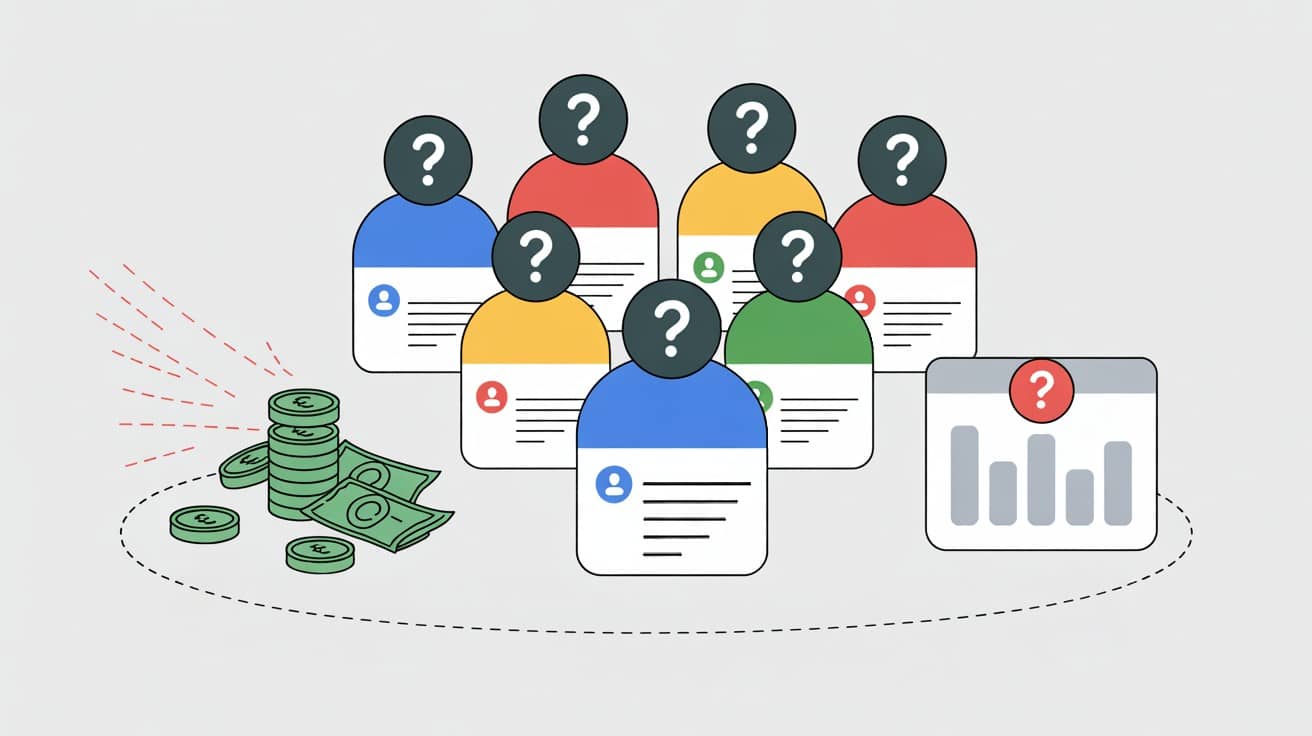
Here’s a number that should make every PPC specialist uncomfortable: 85% of the professionals we spoke with are not using offline conversion tracking.
They are optimising campaigns, reporting on leads, and billing clients. All while feeding Google’s algorithm data that is fundamentally broken. And the worst part? Most of them don’t know it’s happening.
If you manage paid search for clients, whether in-house, at an agency, or as a freelancer, this article is about what that gap is costing you, your clients, and your results. And what the 15% who are getting it right already know.
The Lead Trap: Why Good Numbers in Google Ads Don’t Mean Good Results
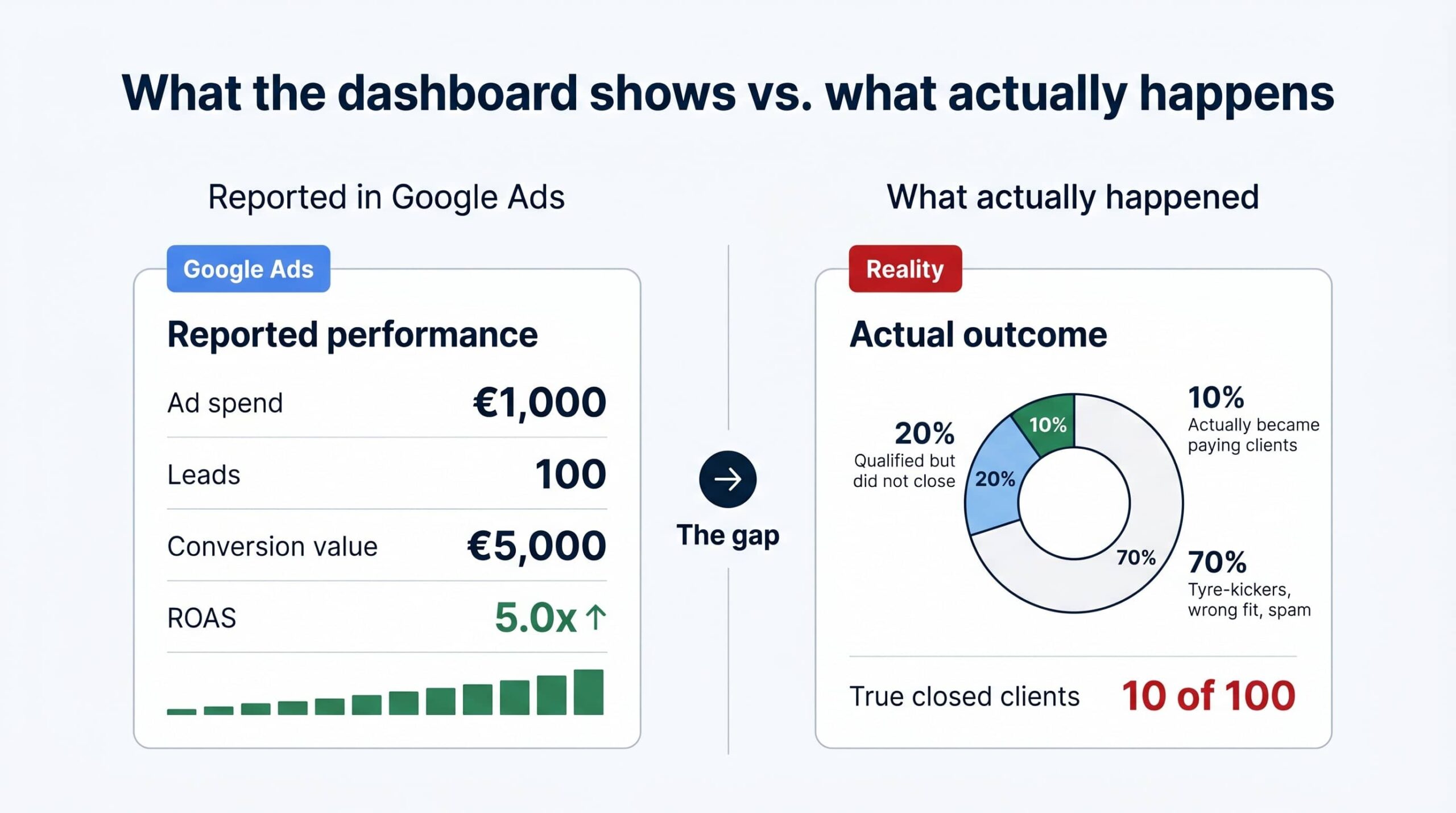
Picture this. You are running a campaign with €1,000 in monthly ad spend. It generates 100 leads, each assigned an average value of €50. Google Ads reports €5,000 in conversion value. Your ROAS looks solid. Your client sees the dashboard and nods.
Now ask yourself: how many of those 100 leads actually became paying clients?
If you cannot answer that question, and most PPC specialists we spoke cannot, then you are not optimising campaigns. You are optimising the illusion of performance.
Your client is answering calls from leads that go nowhere. Their sales team is frustrated. And Google’s algorithm is happily serving more of those same low-quality leads, because you told it everything is working.
This is the lead trap. And it is more common than the industry likes to admit.
Feeding the Algorithm Bad Data: A Technical Perspective
From a data engineering standpoint, the problem is straightforward: garbage in, garbage out.
Google’s Smart Bidding relies on conversion signals to learn which users are most likely to convert. When you pass form submissions as conversions, without ever telling Google which ones closed as actual clients, you are training the algorithm on the wrong outcome.
The algorithm does not know your client’s sales cycle. It does not know that 70 of those 100 leads were tyre-kickers, wrong-fit prospects, or outright spam. It only knows what you tell it. And what you are telling it is that all 100 leads were equally valuable.
Over time, Smart Bidding will optimise towards the profile of those 100 leads, including the 70 that never converted. Your cost per acquisition climbs. Your client’s close rate drops. The cycle continues until someone questions whether PPC is working at all.
This is not a campaign structure problem. It is a data problem. And it has a direct solution.
What Offline Conversion Tracking Actually Does
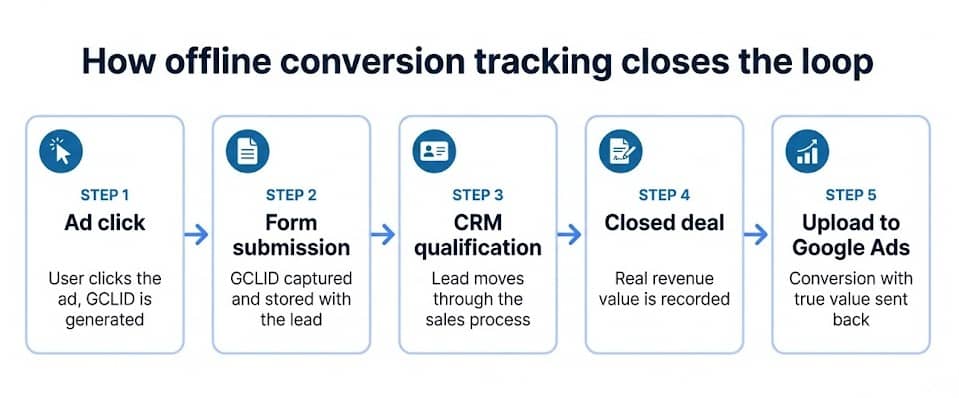
Offline conversion tracking closes the loop between a click and a closed deal.
When a lead submits a form, their Google Click ID (GCLID) is captured at the point of form submission. That identifier follows the lead through your client’s CRM or sales process.
When the lead converts, a signed contract, a completed purchase, a qualified sales call, that conversion event is sent back to Google Ads with the actual value attached.
The result: Google now knows which user profiles, search queries, and placements produced real revenue, not just form submissions. Smart Bidding can then optimise towards the leads that actually convert, reducing wasted spend and improving lead quality over time.
The same principle applies to Meta Ads, LinkedIn Ads, and Microsoft Ads. Every platform benefits from knowing what happened after the click.
There is an additional benefit that has become increasingly important: cookie deprecation. As third-party cookies disappear across browsers, traditional conversion tracking loses coverage. Offline conversion tracking using Enhanced Conversions for Leads, an upload-based method that does not rely on cookies, provides a more durable signal. You track more conversions, more accurately, regardless of the browser environment.
💡 For a deeper technical walkthrough, read guide on offline conversion tracking methods. This article focuses on what it means strategically for you as a PPC specialist.
Why Most PPC Specialists Are Still Not Doing It
In our conversations with PPC professionals, two constraints came up repeatedly:
- Complexity: Traditional offline conversion tracking setups involve scripts, webhook configurations, Zapier workflows, and manual GCLID storage. The technical lift is significant, particularly for agencies managing multiple clients across different CRMs.
- Cost: When the setup requires developer time or third-party automation tools at scale, the economics often do not work for smaller clients.
These are legitimate concerns. But they are also the reason the gap between the 85% and the 15% exists and why that gap represents a real competitive opportunity.
What the Data Actually Shows: A Real Client Example
One Octanist client was spending around €10,000 every 90 days on Google Ads. Despite solid lead volume, they had no visibility into how many of those leads were converting into clients and were actively planning to cut their ad budget.
Their PPC agency implemented offline conversion tracking instead. Over the following period, they qualified all incoming leads within the platform and tied each closed deal back to its original ad click. The result was a conversion value of over €700,000 representing a ROAS above 50.
Cutting the budget would have meant cutting the single largest driver of new client revenue in the business. The data simply was not visible until offline tracking was in place.
This pattern, strong underlying ROAS obscured by incomplete conversion data, is not unique to high-spend accounts. It appears consistently across smaller budgets too. The scale differs; the principle does not.

The Advantage You Can Claim Right Now
Here is what the 15% of PPC specialists already using offline conversion tracking have in common:
- They report on revenue, not leads. Custom columns in Google Ads or a dedicated dashboard show cost per won lead, ROAS on closed deals, and true campaign ROI. That is a fundamentally different conversation with a client.
- They retain clients longer. When you can prove that your campaigns generate actual business, not just pipeline activity, the relationship becomes much harder to walk away from.
- Their algorithms perform better over time. Every qualified conversion sent back to Google trains the model more precisely. Accounts compound in performance rather than plateauing.
- They are future-proofed against cookie deprecation. Upload-based conversion methods do not depend on third-party cookie availability.
The specialists who are not doing this are competing on the same metrics, lead volume, CPL, CTR, that every other agency is using. The ones who are doing it are competing on a different dimension entirely.
How to Get Started Without the Technical Overhead
The traditional implementation barrier, scripts, manual GCLID management, Zapier workflows, is no longer the only option.
Tools like Octanist reduce the setup to a single Google Tag Manager tag and a shared interface where you and your client log in to qualify leads and mark conversions.
From there, the platform handles the upload to Google Ads, Meta Ads, LinkedIn Ads, and GA4 automatically.
For clients with CRM systems, the qualification process can be fully automated via API, meaning closed deals trigger conversion uploads without manual input.
The output is something most PPC specialists have never been able to show a client: the actual cost per won lead, and the revenue generated per campaign.
Stop Reporting Leads. Start Reporting Results.
The 85% figure is not a judgment. It reflects how the industry has operated for years, focused on the metrics that are easy to measure, not the ones that matter most to clients. That is changing.
The PPC specialists who make the shift to offline conversion tracking now are not just improving their campaigns. They are repositioning what they offer, from lead generation to revenue generation. That is a fundamentally more defensible and valuable service.
Whether you use Octanist or another tool, the move is the same: start connecting your clicks to your client’s closed deals. Your campaigns will perform better, your reporting will be more honest, and you will be ahead of the 85% who are still flying blind.
Ready to make the shift? Explore how offline conversion tracking works in practice and see how to set it up without the traditional technical overhead at octanist.com.
Stop optimizing for leads that never close. Octanist shows you which campaigns actually drive revenue, not just form fills.
Connect your lead data, mark leads as won, and Octanist pushes real revenue data to your ad platforms automatically.
See which channels and campaigns actually close deals, so you know exactly where to invest more.

Jorg van de Ven is co-founder of Octanist and a data engineer with extensive experience in marketing analytics and ad platform integrations. He helps businesses and PPC specialists connect their ad spend to real business outcomes through offline conversion tracking. Connect via octanist.com.